
Stress, overwork, and an unhealthy diet can contribute to the depletion of B Vitamins in the body, leading to fatigue, brain fog and more stress.
| Country | Store | |
|---|---|---|
| Malaysia | West Malaysia Sabah Sarawak | |
| Singapore | Singapore | |
| Indonesia | Jakarta | |
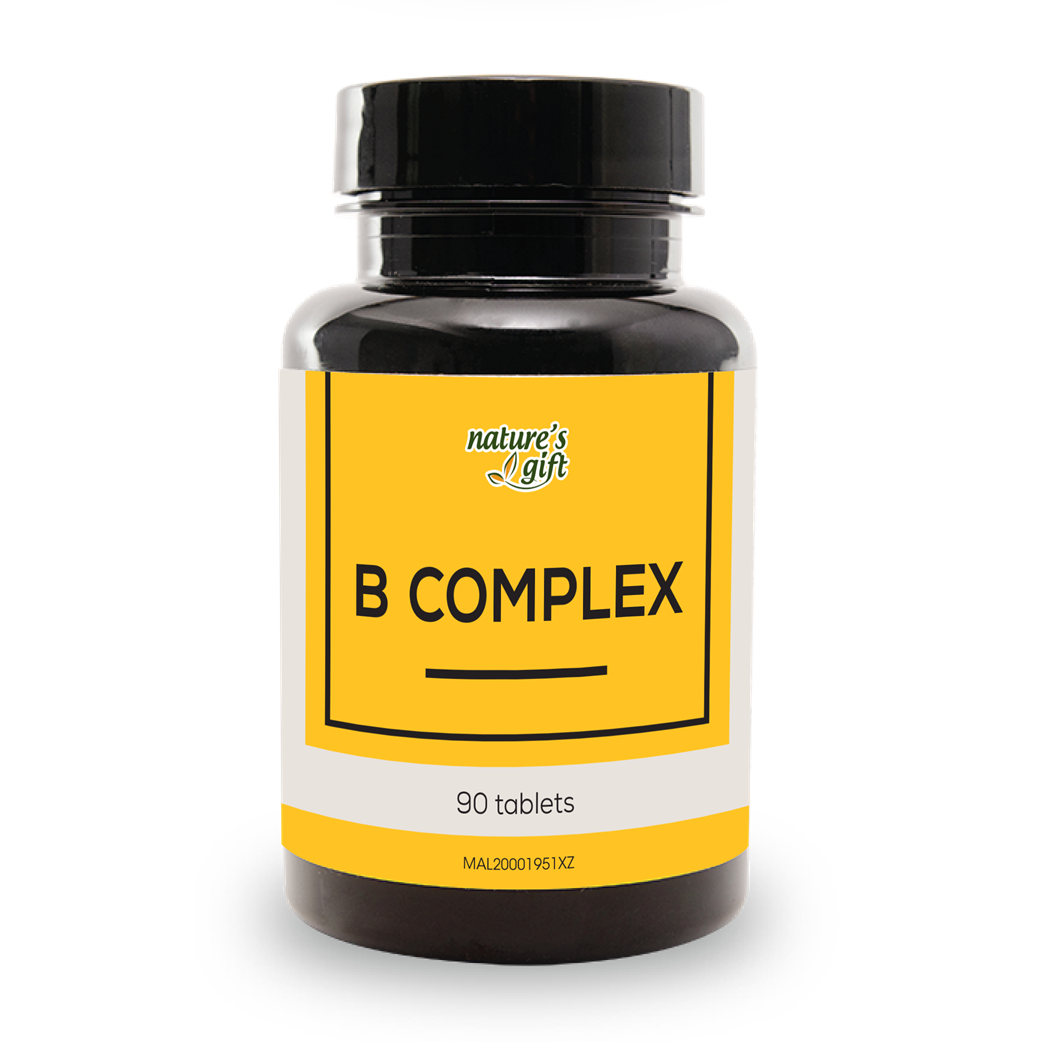
Vitamin B Complex
Essential B Vitamins For Energy Management At A Cellular Level
MAL20001951XZ
Vitamin B Complex
Essential B Vitamins To Support Energy
Key Benefits
Vitamin B1 (Thiamin) helps the body convert carbohydrates into energy
Vitamin B2 (Riboflavin) for growth and development, and for the production of red blood cells
Vitamin B3 (Niacin) supports healthy skin and the nervous system
Vitamin B5 (Pantothenic acid) is essential for the metabolism of food
Vitamin B6 (Pyridoxine) helps the body break down protein and helps maintain the health of red blood cells
Vitamin B7 (Biotin) for the metabolism of proteins and carbohydrates and in the production of hormones and cholesterol
Vitamin B9 (Folic acid) is needed for the production of DNA. It supports prenatal and women’s reproductive health
Vitamin B12 (Cobalamin) plays an important role in the body’s growth and development
Choline helps with brain and memory development
Inositol is required by the body to form healthy cells
Para-aminobenzoic acid (PABA) is an antioxidant that helps repair damage caused by free radicals
An Essential Vitamin For Today’s Fast Paced Lifestyle

Stress, overwork, and an unhealthy diet can contribute to the depletion of B Vitamins in the body, leading to fatigue, brain fog and more stress.
B Vitamins support the adrenal glands and nervous system and overall energy management at the cellular level. They are water soluble, which means that daily intake is needed. Are you getting enough Vitamin B to maintain your health?
In our modern diet, filled with refined carbohydrates, food additives, and chemicals in our food and environment, the answer is probably no!
Benefits of B Vitamins, Backed by Science

It has been concluded that folic acid and Vitamin B6 intake of the recommended dietary allowance (RDA) is important in the prevention of coronary heart disease among women*.
A study conducted in Japan found that coronary heart disease and myocardial infarction are inversely associated with vitamin B6 intake among non-multivitamin supplement users. This research further suggested that folic acid and vitamin B12 may also play an important protective role against heart disease**.
It was evident that vitamin B12 deficiency among older physically disabled women have contributed to 2 times likelihood of developing severe depression, suggesting that adequate intake of B vitamins are essential in maintaining neurological integrity involved in mood regulation***.
It was reported that those who consumed at least 1mg of thiamine a day were linked to significantly lower blood lead levels compared to those with minimal thiamine intake, suggesting that thiamine intake may reduce lead toxicity#.
The study demonstrated that daily supplementation of 400 mg riboflavin was effective in preventing migraine, with progressive reduction of abortive anti-migraine tablets intake. Headache frequency was significantly reduced from 4 days/month at baseline to 2 days/month after 3 months and 6 months daily intake of riboflavin respectively##
Nature’s Gift Vitamin B Complex

Nature’s Gift Vitamin B Complex provides a wide spectrum of B vitamins that fill the nutritional gaps in our daily diet.
It offers a quick and convenient way to help meet our body's demands such as maintaining a healthy heart and digestive system, powering the immune system and energy levels, as well as supporting the nervous system and brain health.
Nature’s Gift Vitamin B Complex is uniquely formulated with the addition of Choline, Inositol and PABA, to provide a wider array of health benefits.
B Complex is recommended for daily consumption for all adults!
Who will benefit especially from Vitamin B Complex?
- Women during menstruation and pregnancy
- Those who are anemic
- The elderly who have poor absorption of vitamins
- Heavy coffee drinkers
- Those who are often tired
- Those who are under stress
- Those who are restless or who have problems sleeping
- If you have difficulty in concentration
Key Benefits
Vitamin B1 (Thiamin) helps the body to maintain good health
Vitamin B2 (Riboflavin) helps metabolise proteins, fats and carbohydrate
Vitamin B3 (Niacin) supports healthy body
Vitamin B5 (Pantothenic acid) is essential for the metabolism of food
Vitamin B6 (Pyridoxine) helps the body to metabolise proteins, fats and carbohydrate
Vitamin B7 (Biotin) for the metabolism of fats and carbohydrates
Vitamin B9 (Folic acid) is needed for formation of red blood cell
Vitamin B12 (Cobalamin) plays an important role in the formation of red blood cell
Inositol is required by the body to maintain healthy body
Ingredients
Choline (Bitartrate) 50mg
Inositol 50mg
Niacinamide 50mg
Pantothenic acid (Calcium pantothenate) 15mg
Vitamin B1 (Thiamine) 10mg
Vitamin B2 (Riboflavin) 10mg
Vitamin B6 (Pyridoxine HCl) 10mg
PABA (para-aminobenzoic acid) 10mg
Folic Acid 100mcg
Biotin 20mcg
Vitamin B12 10mcg
Directions Of Use
-
Adult: Take 1-2 tablets daily with food unless otherwise stated
Directions Of Use
-
Adult: Take 1 tablet daily with food
Vitamin B Complex
Testimonials
Herbal Klenz Powder improved my bowel movements, my skin, and my concentration. I feel fit now because I sleep well at night.
I discovered I had irritable bowel disease (IBD) many years ago. My stomach would feel very uncomfortable after taking hot or spicy foods. I did not go out to look for a cure but instead just bore with the inconveniences and the irritable discomfort.
But one meeting with Dr. Lynn, I understood my digestive system better and stopped feeling helpless in restoring my health. Her advice to me on what I should take for my meals and what I must forgo has given me a real boost, so I decided to change my diet. I was also advised to take GI Health Plus Pack, which consists of Pure Raw Honey, ACV, Herbal Klenz Powder, C Complex and Immuflora to take care of my guts. These products have liberated me from my condition as my stomach is able to cope with hot or spicy stuff. I do not feel uncomfortable anymore.
I strongly believe that this is the first step towards prevention from getting other degenerative illnesses as I grow older. There us so much we can do in achieving optimal health through diet, exercise, and rest, despite this very toxic lifestyle and environment we live in. We just need some right advice and encouragement to do the right thing before it is too late!
Cheers to good health and long life!
Resources
* The contents on this page are not to be substituted for medical advice or diagnosis. The information presented here is purely for educational purposes. This is not a prescription for self-diagnosis or self-medication. Consult your own physician regarding the application of any opinions and recommendations with respect to your symptoms or medical conditions.
*Rimm, E.B., Willett, W.C., Hu, F.B., Sampson, L., Colditz, G.A., Manson, J.E., Hennekens, C. and Stampfer, M.J. 1998. Folate and vitamin B6 from diet and supplements in relation to risk of coronary heart disease among women. Journal of the American Medical Association 279: 859-864.
**Ishihara, J., Iso, H., Inoue, M., Iwasaki, M., Okada, K., Kita, Y., Kokubo, Y., Okayama, A. and Tsugane, S. 2008. Intake of folate, vitamin B6 and Vitamin B12 and the risk of CHD: the Japan public health center-based prospective study cohort I. Journal of the American College of Nutrition 27: 127-136.
***Penninx, B.W.J.H., Guralnik, J.M., Ferrucci, L., Fried, L.P., Allen, R.H. and Stabler, S.P. 2000. Vitamin B12 deficiency and depression in physically disabled older women: epidemiologic evidence from the women’s health and aging study. American Journal of Psychiatry 157: 715-721.
#Lee, M-G., Chun, O.K. and Song, W.O. 2005. Determinants of the blood lead level of US women of reproductive age. Journal of the American College of Nutrition 24: 1-9.
##Boehnke, C., Reuter, U., Flach, U., Schuh-Hofer, S., Einhäupl, K.M. and Arnold, G. 2004. High-dose riboflavin treatment is efficacious in migraine prophylaxis: an open study in a tertiary care centre. European Journal of Neurology 11: 475-477.
Resources
* The contents on this page are not to be substituted for medical advice or diagnosis. The information presented here is purely for educational purposes. This is not a prescription for self-diagnosis or self-medication. Consult your own physician regarding the application of any opinions and recommendations with respect to your symptoms or medical conditions.